The Cellist
Her hands are insured. That is the sentence she offered, laughing, in the tea conversation — a principal cellist with a desert orchestra, forty-one years old, in Las Vegas for a residency, whose fingers are worth a policy and whose shoulders are worth, she said, considerably less. Everything I am is in my hands, she said. Nobody has ever once taken care of them. Or of me. The job is to be the instrument.
She booked the Deep Ritual, 120 minutes, and arrived straight from rehearsal with rosin still ghosting her fingers. The maison began, as it always begins, everywhere else: the approach moved over her shoulders — a cellist's shoulders, architecture built by thirty years of holding — and her back, and her hips, with the patience the practice reserves for people who give all day.
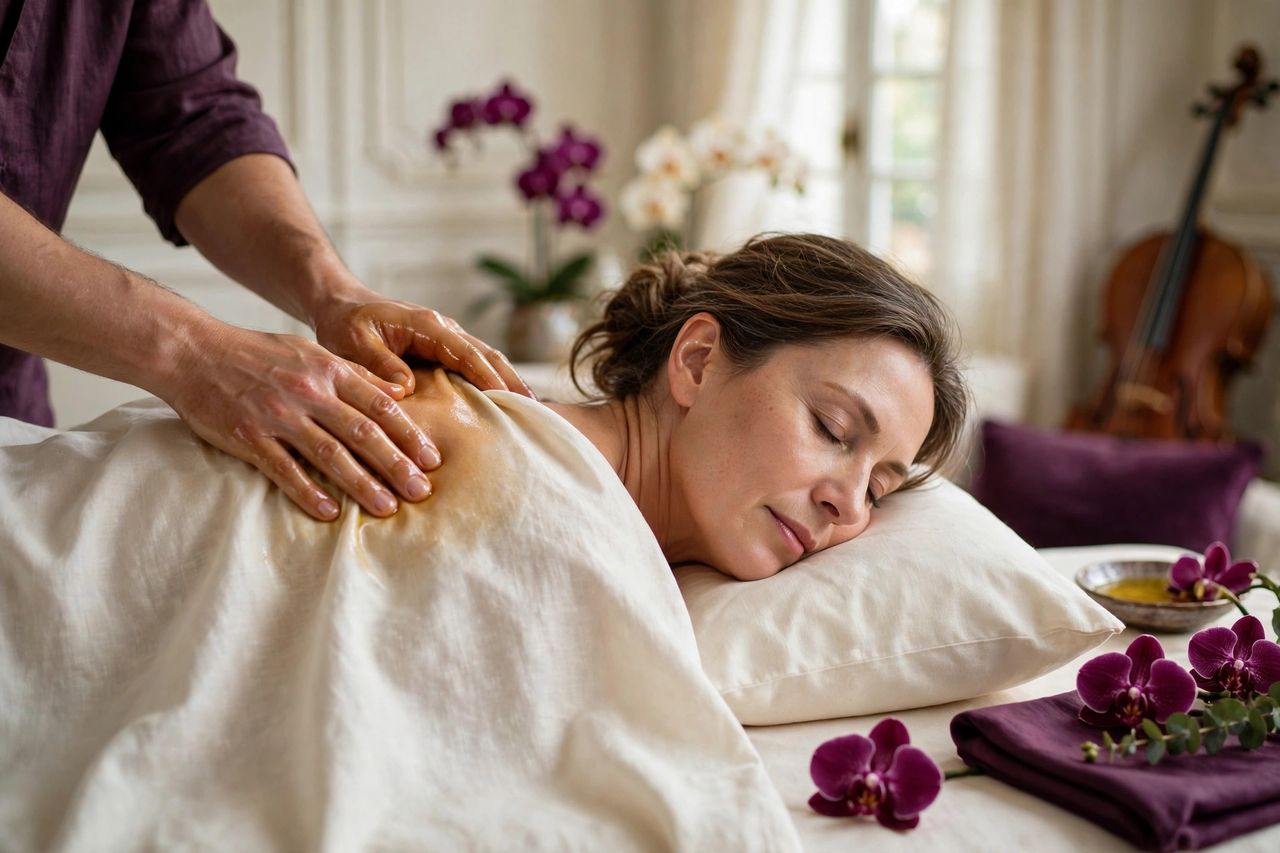
What she wrote afterward dwells on the turn. He treated the centre of me the way I treat a phrase by Bach — as if it had been composed, and deserved to be played exactly as written. Nothing rushed. Nothing shown off. Just… fidelity. Her responses conducted, and the ritual followed — pressure, tempo, stillness — the way an accompanist follows a soloist he has decided to serve completely.
At some point she laughed — she reports this with wonder — a short, surprised laugh in the middle of the deepest quiet, because her body had produced a feeling she had no technique for. I have performed in nine countries, she wrote. I did not know that was in the repertoire.
The residency ends in spring. She has booked monthly until it does, and her note in the maison's book is the one the practitioners quote to new guests who arrive apologising for taking up the room: You are not the instrument here. For once, you are the music.